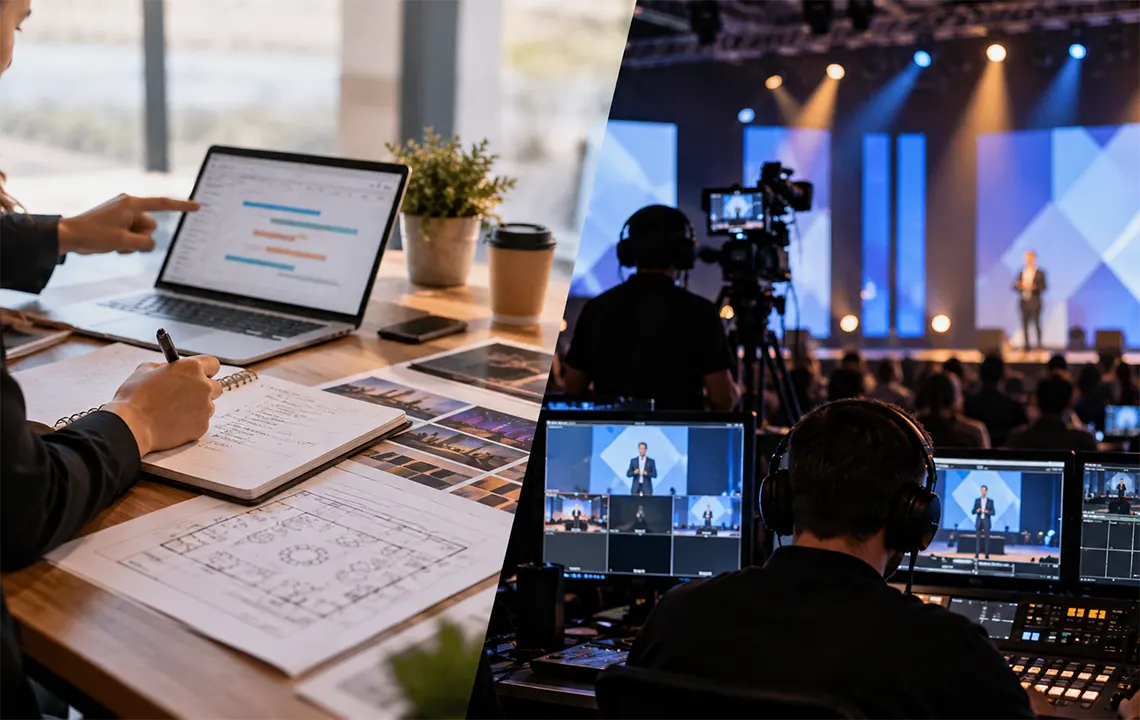
Event planning and event production are closely connected, but they are not the same job.
Event planning focuses on organizing the event as a whole: the goals, attendees, venue, schedule, vendors, budget, registration, catering, speakers, and countless other details that have to come together.
Event production focuses on how the event is technically and visually executed. It turns the plan into what the audience actually sees, hears, and experiences through audio, video, lighting, staging, presentation systems, show control, recording, livestreaming, and technical crew coordination.
Understanding the difference between event planning and event production is important because even a carefully organized event can struggle if the technical execution is treated as an afterthought. At the same time, sophisticated production cannot compensate for an unclear agenda, unrealistic schedule, or poorly defined event objectives.
The strongest events bring both disciplines together early enough for planning decisions and production decisions to support each other.
What Is Event Planning?
Event planning is the broader process of organizing an event from concept through completion.
Depending on the size and type of event, an event planner, internal events team, agency, marketing department, or meeting planner may manage responsibilities such as:
- Defining the purpose and goals of the event
- Developing and managing the budget
- Selecting and coordinating with the venue
- Managing attendee registration
- Planning food and beverage
- Coordinating speakers and presenters
- Arranging travel or accommodations
- Creating the event schedule
- Managing sponsors and exhibitors
- Coordinating vendors
- Handling guest communications
- Developing contingency plans
- Tracking deadlines and approvals
The planner generally looks at the event from a wide operational perspective.
For example, a planner organizing a corporate conference may decide that the program will include an opening keynote, two panel discussions, breakout sessions, lunch, an awards segment, and a closing presentation.
Those decisions establish the structure of the event.
But another set of questions immediately follows.
How will the keynote presentation appear on screen? How many microphones will the panel require? Will cameras be used so the audience can see presenters more clearly? How will videos be played? What lighting changes are needed during the awards segment? Who advances presentation slides? What happens if a remote presenter joins the program? Who is responsible for each technical cue?
Those questions move into event production.
What Is Event Production?
Event production is the process of designing, coordinating, installing, operating, and managing the technical elements that make an event work in real time.
The exact production scope varies considerably. A simple meeting may require only a presentation display, a few microphones, speakers, and basic technical support. A conference or product event may involve multiple screens, cameras, stage lighting, presentation playback, graphics, recording, streaming, scenic elements, and a dedicated technical crew.
Production may include areas such as:
Audio
The production team determines how presenters, panelists, performers, videos, and other program audio will be heard clearly.
That may involve microphones, speakers, audio consoles, playback systems, monitors, and audio engineers.
The goal is not simply to make the event louder. The system must provide appropriate coverage and intelligibility throughout the audience area while supporting the different types of content in the program.
Video and Presentation Systems
Video production can include projectors, projection screens, LED displays, confidence monitors, presentation computers, video switchers, cameras, graphics, and playback systems.
A video switcher, for example, allows an operator to select which source appears on a screen or recording at a given moment. That source might be a presentation, camera shot, video clip, graphic, or another computer.
Lighting
Production lighting helps presenters remain visible while also shaping the look of the room and stage.
Different events may use stage lighting, room lighting, architectural lighting, scenic lighting, or programmed lighting changes associated with specific moments in the program.
Staging and Scenic Elements
Production teams may also need to coordinate stages, lecterns, backdrops, displays, scenic structures, and other physical elements around the presentation environment.
These elements have to work not only visually but also practically. Presenters need safe access to the stage, screens must remain visible, cameras need appropriate sightlines, and technical equipment requires suitable positions.
Recording and Livestreaming
If the event needs to reach an online audience or create content for later use, recording and streaming requirements become part of the production design.
That can affect camera placement, audio routing, graphics, internet requirements, lighting, staffing, and rehearsal plans.
Show Operation
Once the event begins, technical elements need to happen at the correct moment.
Someone may need to cue a video as a speaker finishes a sentence, switch from slides to a camera shot, adjust the stage lighting, open a microphone for audience questions, or prepare the next presenter.
For complex programs, these actions are often coordinated through a run of show and a process called show calling. A show caller communicates upcoming cues to the appropriate teams so that technical and program transitions remain coordinated.
Event Planning vs. Event Production at a Glance
The easiest way to understand the difference is to compare what each discipline is primarily responsible for.
| Area | Event Planning | Event Production |
|---|---|---|
| Event goals | Defines the purpose and desired outcomes | Designs technical execution around those goals |
| Budget | Manages the overall event budget | Develops and manages the technical production scope |
| Venue | Selects and coordinates the venue | Evaluates technical capabilities and limitations |
| Agenda | Creates the program schedule | Determines how each program element will be executed |
| Speakers | Books and coordinates presenters | Provides microphones, displays, playback, lighting, and technical cues |
| Attendees | Manages registration and guest experience | Supports what attendees see and hear |
| Vendors | Coordinates overall suppliers | Coordinates technical equipment, crew, staging, and production systems |
| Branding | Establishes creative and brand requirements | Implements branding through screens, stage visuals, lighting, and media |
| Event day | Oversees the overall event | Operates technical systems and executes show cues |
There is significant overlap between the two. That overlap is exactly why communication between the planning and production teams matters.
The Planner Defines What Needs to Happen; Production Determines How It Happens
One useful way to think about the relationship is that planning describes the intended event, while production translates that intent into an executable technical system.
Imagine that the planner says:
“The CEO will open the event, show a short video, give a 20-minute presentation, and then invite three executives to the stage for a panel discussion.”
That sounds straightforward from an agenda perspective.
From a production perspective, however, it creates many decisions.
The production team may need to determine:
- How the opening walk-on will be handled
- Whether entrance music is required
- Which microphone the CEO will use
- Where presentation slides will originate
- How the video will be played
- How video audio will reach the sound system
- Whether the presenter needs a confidence monitor
- Whether cameras will show the speaker on audience screens
- How the stage will change from a keynote setup to a four-person panel
- Which microphones the panelists will use
- Who will manage each transition
- Whether the presentation and panel will be recorded or streamed
The planner does not necessarily need to design these systems.
The planner does, however, need to communicate the program clearly enough for the production team to develop them.
Why Event Production Should Be Involved Before Event Day
A common misconception is that event production begins when equipment arrives at the venue.
In reality, many of the most important production decisions happen much earlier.
The event agenda can influence equipment requirements. The venue can affect screen size, speaker placement, lighting positions, power requirements, crew schedules, and setup time. The stage layout can influence camera positions and audience sightlines. Livestreaming requirements can affect internet planning and staffing.
Waiting until the schedule, room layout, or venue agreement is effectively finalized can reduce the options available to the production team.
Early production involvement is especially helpful when an event includes:
- Multiple presenters
- Panel discussions
- Several presentation screens
- LED walls or large-format projection
- Live camera coverage
- IMAG, or image magnification for the in-room audience
- Recorded sessions
- Livestreaming or webcasting
- Remote speakers
- Multiple rooms or breakout sessions
- Detailed lighting cues
- Entertainment
- Complex stage transitions
- Extensive presentation playback
- A tightly timed run of show
When the technical scope becomes more complex, professional event production services can help translate the planner’s program requirements into a workable AV,