Choosing between an LED wall or projection for a corporate stage is not simply a matter of deciding which technology looks newer or more impressive. Both can produce professional, large-format visuals. The better choice depends on what the audience needs to see, how the venue is configured, how much ambient light is present, what type of content will be displayed, and how the screen fits into the overall stage design.
For some conferences, a properly sized projection system is practical, clean, and cost-effective. For a brightly lit product launch or highly branded general session, an LED video wall may give the production team much more control. In other cases, the strongest solution is a combination of the two.
Here is how we evaluate LED wall vs projection when designing visual systems for corporate events.
LED Wall vs Projection: The Basic Difference
Both systems can serve the same basic purpose: putting presentations, videos, graphics, remote speakers, and live camera feeds in front of an audience.
They create that image in very different ways.
A projection system sends light from a projector onto a separate screen. The final image therefore depends on the projector, lens, screen surface, image size, throw distance, and the amount of light hitting that screen.
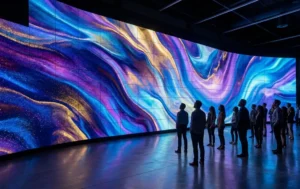
An LED wall is a direct-view display. The individual LED panels generate the image themselves. Multiple panels are assembled into one large display, and a video processor maps the incoming content across the complete canvas.
On our site, you will see both LED Wall Rental and the more specific LED Video Wall Rental category. In practical corporate event planning, the terms “LED wall” and “LED video wall” are commonly used for the same general direct-view display technology.
Projection is organized around the Projectors & Screens system: the projector and projection surface have to be selected together rather than treating either component in isolation.
That difference becomes important once you start considering the room.
Choose LED When Ambient Light Is Hard to Control
One of the strongest reasons to use an LED wall is brightness.
Corporate stages are not always dark theaters. You may have stage wash lighting, architectural lighting, large windows, exhibit lighting, camera lighting, or a client who simply does not want the ballroom to feel dark during presentations.
Projection can work in rooms with some ambient light, but light falling directly on the projection surface reduces perceived contrast. Dark areas of the image become lighter, colors can feel less saturated, and fine details may become harder to distinguish.
Increasing projector brightness can help, but it does not completely solve poor lighting conditions. Screen size also matters: spreading a projected image across a larger surface reduces the amount of light available per unit of screen area.
An LED wall generates its own light, so it is much less dependent on a darkened environment. This makes LED particularly useful for:
- Product launches with bright stage lighting
- Corporate meetings where the room needs to remain illuminated
- Stages close to large windows
- Brand events with saturated graphics and video content
- Exhibitions and activations with high ambient light
- Events where visual impact is a major part of the stage design
This does not mean an LED wall should always be operated at maximum brightness. In an indoor conference environment, an excessively bright wall can become uncomfortable for the audience and can make camera exposure more difficult. Brightness should be balanced with the room, lighting design, camera system, and viewing distance.
The advantage is control: LED gives the production team more brightness headroom when the environment demands it.
Projection Can Be Excellent When the Room Supports It
LED has major advantages, but projection remains extremely useful for corporate events.
In a ballroom or meeting space where lighting can be managed effectively, a properly engineered projection system can create a large, clean image without turning the entire back wall into an electronic display.
For a traditional corporate general session focused on PowerPoint presentations, charts, speaker support, and occasional video, projection may be all the visual system needs.
Our projector rental options include solutions intended for different room sizes and applications, while the screen system can be selected separately according to the stage layout.
Projection is especially worth considering when:
- The room can be adequately darkened around the screen
- The content is primarily presentations and business graphics
- A standard widescreen format works with the stage design
- The audience is seated at predictable viewing angles
- The venue provides suitable projector positions
- The production budget needs to prioritize other AV elements
The key is to design the system around the actual venue. A projector that performs well on one stage may be a poor choice on another because the screen is larger, the throw distance is different, or the room has substantially more ambient light.
Consider the Closest Viewer Before Choosing an LED Pixel Pitch
With projection, event planners frequently discuss screen size and projector brightness. With LED, another specification becomes critical: pixel pitch.
Pixel pitch is the distance between neighboring LED pixels, typically measured in millimeters. A smaller pixel pitch places the pixels closer together, producing greater pixel density.
That matters because corporate audiences may sit relatively close to the stage.
A large LED wall intended for an audience twenty or thirty feet away can use a different panel configuration than an LED display positioned immediately behind presenters while attendees sit close to the front row.
For presentation-heavy events, fine text is another consideration. A display showing detailed charts, spreadsheets, application interfaces, or small labels needs enough effective resolution for the intended viewing distance.
The correct question is therefore not simply:
“How large should the LED wall be?”
It is:
“How large should the wall be, how close is the nearest viewer, and what type of content will appear on it?”
Screen dimensions, pixel pitch, content resolution, and audience distance should be evaluated as one system.
Compare the Space Required Behind and Around the Stage
Available space can quickly change the LED wall vs projection decision.
Front Projection
With front projection, the projector sits on the audience side of the screen.
Depending on the projector and lens, it may be positioned on the floor, on a platform, or flown from an appropriate structure. The projection beam must remain unobstructed.
This creates practical questions:
- Can people walk through the beam?
- Will the projector interfere with seating?
- Can it be flown safely?
- Is there a suitable throw distance?
- Will the projector location affect camera positions?
- Can stage lighting be kept off the screen?
A projector with an appropriate lens can often solve these challenges, but the complete layout has to be considered.
Rear Projection
Rear projection moves the projector behind the screen. This can create a cleaner audience-facing setup because speakers can walk in front of the screen without casting shadows into the image.
The tradeoff is backstage depth.
The production must reserve enough distance behind the screen for the projection path, equipment, access, and safety. In a ballroom where every foot of floor space matters, that can become a significant limitation.
Our projection screen rental options include different formats and sizes that can be incorporated into event layouts, but the screen and projector should always be planned together.
LED Wall
LED eliminates the projector throw path, which can be extremely valuable on some stages.
However, LED has its own structural requirements. The panels need an appropriate support method, which may involve ground support or venue-approved rigging. The system also requires video processing, signal distribution, power, cabling, and service access.
So LED does not necessarily mean “no space required.” It changes the type of space and infrastructure required.
A venue survey can often reveal the right answer faster than a specification sheet.
Think About Stage Lighting Before Choosing the Screen
The display and the lighting system should not be designed independently.
Projection screens work best when unnecessary lighting is kept off the image surface. At the same time, presenters need enough front light to look natural to the room and on camera.
That sometimes creates a balancing act. The lighting designer may need to carefully shape the stage wash so speakers are illuminated without washing out the projected image.
LED walls give the lighting team more flexibility because the display is less vulnerable to light spill. That can be particularly helpful for stages where the screen occupies most of the backdrop.
But LED creates a different challenge: the wall itself becomes a large light source.
If a presenter stands directly in front of a bright LED background, the camera department may need to balance the wall brightness with front lighting. Otherwise, the screen can look properly exposed while the presenter appears too dark—or the speaker looks correct while the wall appears excessively bright.
For polished corporate production, display brightness, stage lighting, camera exposure, and content design should be tested together.
LED Gives Stage Designers More Freedom With Shape and Aspect Ratio
Projection usually works best when you want a conventional rectangular image.
That is not necessarily a limitation. Corporate presentations are commonly produced in 16:9, so a large widescreen projection surface often matches the content perfectly.
LED becomes especially interesting when the screen itself is part of the scenic design.
Because an LED video wall is assembled from modular panels, it can potentially be configured into dimensions that are not based on a standard projection screen.
A production might use:
- One very wide LED canvas
- A central display with supporting side sections
- Multiple separate LED surfaces
- Tall vertical video elements
- A panoramic branded background
- A screen integrated with scenic structures
This flexibility allows graphics to become part of the environment rather than appearing only inside a traditional 16:9 rectangle.
There is an important content requirement, however: custom LED dimensions usually require custom content preparation.
If your design team creates every asset at 1920 × 1080 and the final LED canvas is extremely wide, the video team must decide whether to scale, crop, letterbox, or place that content inside a larger graphic layout.
The display design should therefore be communicated to the content team early.
Projection Is Often a Strong Choice for Presentation-Heavy Events
Corporate events frequently revolve around slides.
Keynotes, financial updates, training sessions, executive meetings, educational presentations, panel discussions, and internal conferences may spend most of the program showing PowerPoint or Keynote content.
Projection can be very effective in this environment.
A well-designed presentation does not necessarily benefit from being placed on an elaborate LED canvas. If the audience needs a clean 16:9 image with large text, charts, speaker names, and occasional video playback, projection may provide exactly what is required.
The money saved on an unnecessarily complex display system may be better invested elsewhere—for example in audio, stage lighting, additional cameras, recording, streaming, rehearsal time, or technical staffing.
The objective is not to install the most expensive display technology. It is to choose the visual system that supports the communication goal.
LED Can Be the Better Choice for Brand-Driven Events
The balance changes when the screen is also a scenic element.
Consider a product launch where the display needs to remain visually active before the presentation begins, surround the product with animated branding, transition between speakers, support full-screen video, and become the background for event photography.
An LED wall can handle all of those roles at once.
Instead of having a separate scenic backdrop and presentation screen, the video display can become a major component of the stage environment.
That is particularly useful when the creative plan includes:
- Large animated brand graphics
- Product videos
- Dramatic session openers
- Countdown sequences
- Speaker walk-on graphics
- Sponsor loops
- Multiple content windows
- Live social or data feeds
- IMAG combined with branded backgrounds
For this kind of production, the value of LED is not simply higher brightness. It is the ability to treat the entire display as a flexible digital canvas.
Consider IMAG and Camera Production
For a larger corporate audience, a screen may need to show more than slides.
IMAG, short for image magnification, uses live cameras to place close-up views of speakers on large screens so people farther from the stage can see facial expressions, demonstrations, and panel discussions more clearly.
Both LED walls and projection screens can display IMAG.
If live camera production is part of the event, however, the video system needs to be planned as a complete signal chain:
camera → video switcher → graphics/presentation sources → processor → audience display
The production may switch between full-screen slides, full-screen cameras, picture-in-picture layouts, remote participants, playback, and branded graphics.
LED can work especially well for these layouts because a large custom canvas can be divided into multiple visual zones.
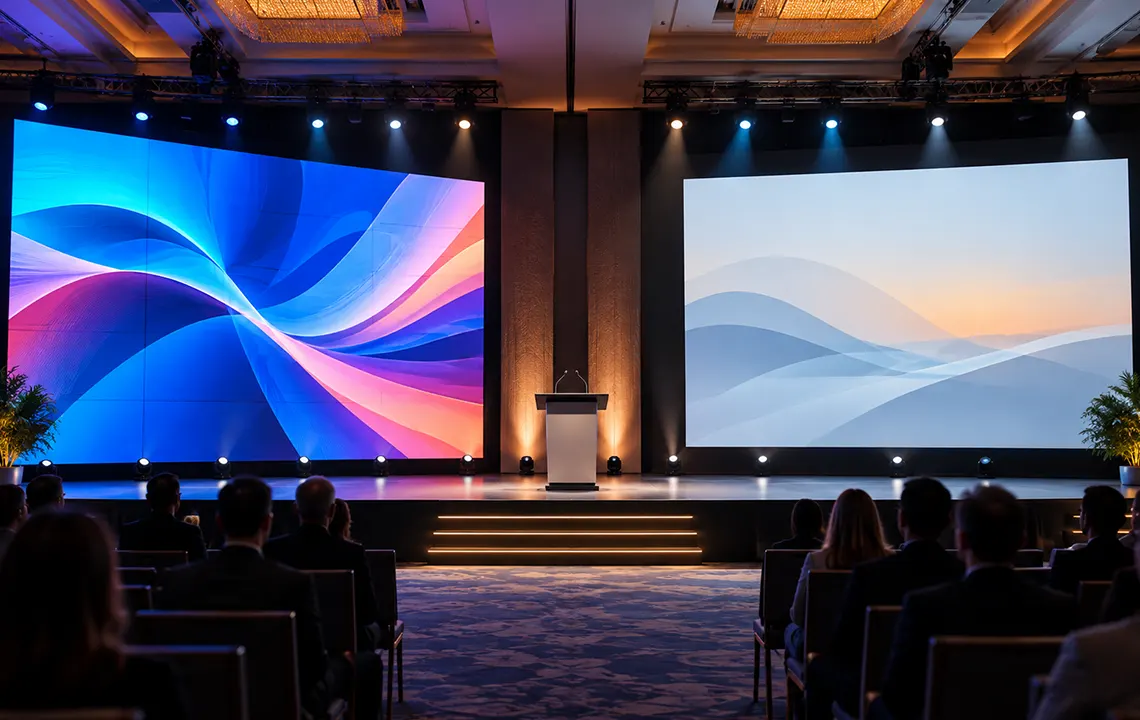
Projection can also support sophisticated switching. Two large projection screens positioned on either side of a stage, for example, may be an excellent way to provide IMAG without replacing the entire scenic background with LED.
The right choice depends on sightlines and content—not simply on whether cameras are being used.
For corporate events combining presentations, video, audio, lighting, staging, cameras, and show operation, it is useful to consider the display as part of the broader corporate event AV system rather than an isolated rental item.
Do Not Compare Equipment Prices Alone
Budget is an important part of the LED wall vs projection decision, but comparing the rental price of an LED panel with the rental price of a projector does not tell you the actual production cost.
The complete LED system may involve:
- LED panels
- Processing
- Structural support or rigging
- Power distribution
- Cabling
- Video switching
- Setup labor
- LED technicians
- Content configuration
A projection system may involve:
- Projector
- Appropriate lens
- Projection screen
- Screen dress kit
- Rigging or projector platform
- Signal distribution
- Video switching
- Setup and alignment
- Technical operation
Venue labor rules, installation schedules, rigging requirements, load-in access, stage configuration, and event duration may also change the total.
LED is often a larger investment, particularly for large fine-pitch walls, but the comparison should always be made at the system level.
In some rooms, choosing projection can substantially simplify the visual package. In others, trying to force projection into a bright or awkward venue can introduce additional equipment and compromises that reduce the apparent savings.
LED vs Projection: A Practical Comparison
| Factor | LED Wall | Projection |
|---|---|---|
| Ambient light | Strong choice for bright environments | Best with controlled light |
| Standard presentations | Excellent, but may be more system than necessary | Excellent |
| Brand-heavy stage design | Highly flexible | More dependent on screen shape |
| Custom aspect ratios | Very flexible | Usually better suited to conventional formats |
| Projector throw space | Not required | Required for front or rear projection |
| Backstage depth | Usually less dependent on optical throw distance | Rear projection can require significant depth |
| Rigging/structural planning | Often important | Depends on projector and screen installation |
| Power requirements | Can be substantial for large walls | Varies by projector system |
| Fine text | Depends heavily on pixel pitch and viewing distance | Can be very sharp with the correct resolution and system |
| IMAG | Excellent | Excellent |
| Bright scenic backdrop | Excellent | More sensitive to stage lighting |
| Budget efficiency | Depends heavily on wall size and pixel pitch | Often attractive when the environment supports projection |
No single row determines the answer. A successful system balances all of them.
When a Hybrid Display Design Makes More Sense
The decision does not always have to be LED or projection.
Large corporate productions frequently benefit from using different display technologies for different jobs.
For example, you might use a central LED wall as a digital stage backdrop while using projection screens farther left and right for IMAG. This allows the LED canvas to remain visually creative while giving attendees at the edges of the room a clear view of speakers.
Another event might use projection as the primary presentation system in the main general session and smaller direct-view displays in networking or sponsor areas.
A production team should select each display based on its purpose.
This is also why screen selection belongs within the larger event production planning process. Video, audio, cameras, lighting, rigging, staging, and content all affect one another.
Questions to Answer Before Making the Decision
Before requesting an LED wall or projector, give your AV team enough information to engineer the system properly.
Start with these questions:
- What are the stage dimensions?
- What is the room’s ceiling height?
- How many attendees will be seated in the room?
- How far is the closest audience member from the screen?
- How far away is the last row?
- Can room lighting be controlled during presentations?
- Are there windows or strong architectural light sources?
- What type of content will be displayed?
- Is the presentation primarily 16:9?
- Will you show live cameras or IMAG?
- Will remote presenters appear on screen?
- Is the event being livestreamed or recorded?
- Does the screen need to function as part of the scenic design?
- Are there approved rigging points?
- How much load-in and rehearsal time is available?
These answers are far more useful than simply requesting “a big screen.”
So, Should You Use an LED Wall or Projection?
Use an LED wall when brightness, scenic flexibility, visual impact, or custom display dimensions are priorities. LED is particularly valuable when the room is bright, the screen needs to function as a digital backdrop, or the creative design requires more than a standard rectangular presentation surface.
Choose projection when the venue provides good light control, the stage layout supports an appropriate projection path, and the event is primarily focused on conventional presentations, video playback, or IMAG. A professionally designed projection system can still deliver an excellent corporate stage without unnecessary complexity.
And consider combining the technologies when different parts of the room have different visual requirements.
At Megahertz Productions, we can evaluate the venue, audience layout, presentation content, lighting, cameras, stage design, and technical requirements before recommending a display system. If you are planning a corporate event and deciding between LED wall rental and projection, share your venue information and production goals with our team so we can help you build a practical visual solution rather than simply selecting a screen from a list.